Archangel Michael Tattoo Meaning: Symbols, Scripture and History
·Vladimir Kozachenko
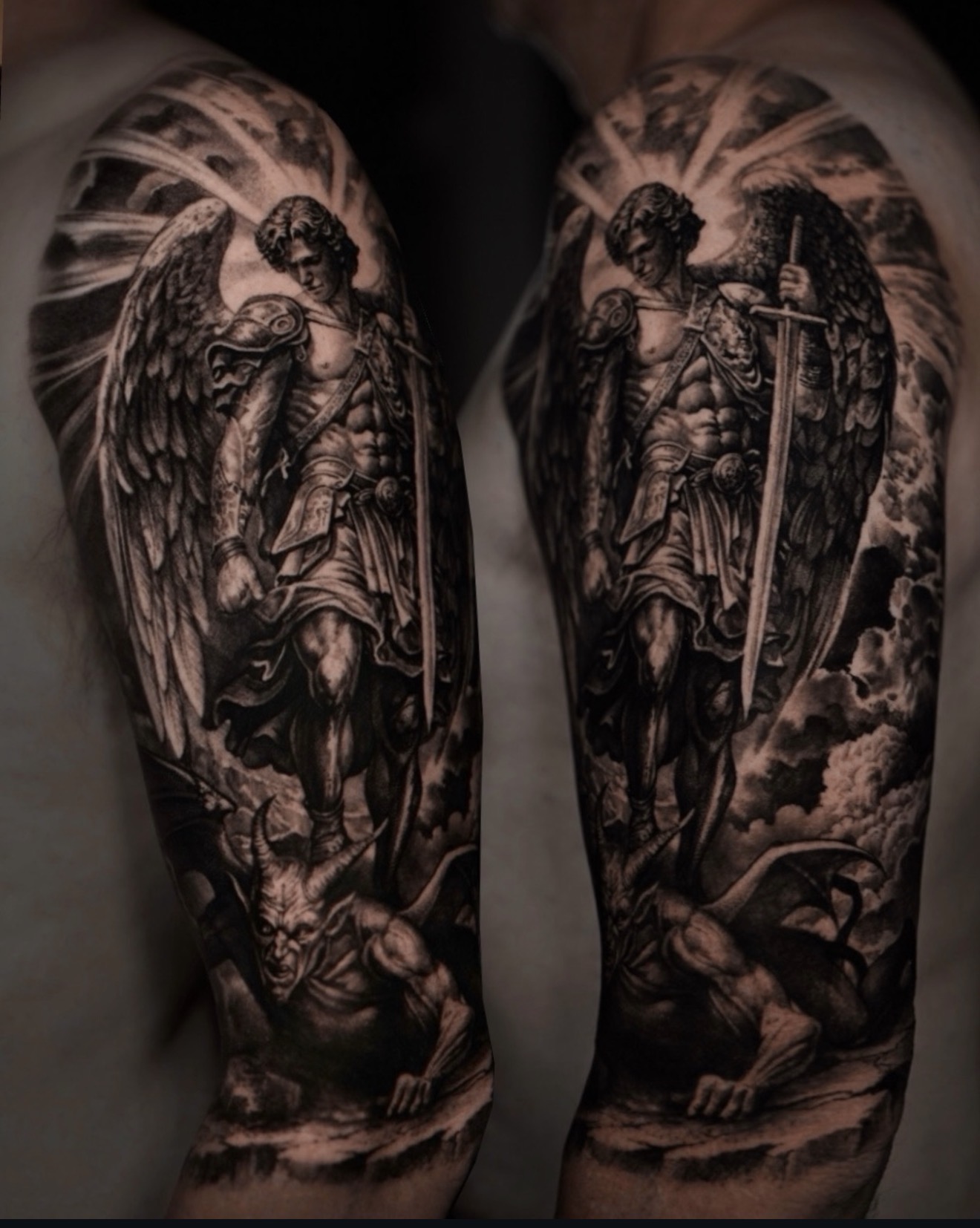
Saint Michael the Archangel is one of the oldest and most powerful images in Christian art, and one of the most requested sacred subjects in black and grey realism. Before it is a tattoo, it is a statement: that evil can be faced and defeated. This is what the image means, where it comes from, and what each of its elements says.
Who is the Archangel Michael
His name in Hebrew, Mi-ka-El, is a question: "Who is like God?" It is not a boast but a challenge, and the answer is: no one. In Latin the same words, Quis ut Deus, are often written on his shield.
Michael is one of the few angels named in the Bible. The Book of Daniel calls him "the great prince" who stands guard over his people (Daniel 12:1). The Letter of Jude calls him "the archangel" (Jude 1:9). In the Book of Revelation he leads the armies of heaven in the war against the dragon (Revelation 12:7-9).
In Catholic and Orthodox tradition he is the commander of the heavenly host. In the Eastern Church his title is Archistrategos, the supreme commander. The Catholic Church celebrates him on 29 September, Michaelmas; the Orthodox Church on 8 November (21 November in the Julian calendar).
The war in heaven
The scene almost every Michael tattoo is built on comes from Revelation 12. War breaks out in heaven: Michael and his angels fight against the dragon, "that old serpent, called the Devil, and Satan", and the dragon is cast down to earth.
This is why Michael is never shown at rest. He is shown at the moment of victory: standing, armed, with the defeated enemy beneath his feet. The scene is not about violence. It is about order being restored.
The meaning of each symbol
The sword. Divine justice and the power to cut through evil. A raised sword is the strike itself; a sword held point-down is victory already won, authority at rest.
The spear. In many classical paintings Michael pins the dragon with a spear instead of a sword: the same victory shown as one decisive act.
The armour. The armour of faith. Saint Paul writes: "Put on the whole armour of God, that ye may be able to stand against the wiles of the devil" (Ephesians 6:11). Michael is that armour made visible.
The shield. Protection, and often the inscription Quis ut Deus, the meaning of his name.
The wings. He is not a man but a messenger of heaven, a being between God and the world.
The scales. Michael weighing souls does not come from the Bible but from medieval tradition and paintings of the Last Judgement. With scales the image speaks of judgement, honesty and the weight of a life.
The defeated devil or dragon. Evil overcome, not ignored. For many people this is the heart of the tattoo: a battle they have already come through, or one they intend to win.
The light from above. Michael does not win by his own strength. The rays breaking through the clouds show where the victory comes from.
What a Saint Michael tattoo means to the person who wears it
Protection: for yourself, for your family, for the people you are responsible for.
Strength in a hard fight: a period of life that had to be survived and was.
Justice and duty. Michael is honoured as the patron saint of police officers and is widely regarded as the patron of soldiers and paratroopers.
Faith: a quiet statement of belief that needs no words. Many people add a line from the Prayer to Saint Michael, written by Pope Leo XIII in the late nineteenth century: "Saint Michael the Archangel, defend us in battle."
Memory: a guardian for someone who is gone.
Saint Michael on the shoulder
A half sleeve by Vladimir Kozachenko at KAZENTATTOO. Michael stands with the sword held point-down: the battle is already over. A horned demon crouches beneath his foot, and rays of light break through the clouds behind his wings. Black and grey realism, built like a carved statue lit from above.
Questions people ask
What does an Archangel Michael tattoo mean?
Protection, strength and the victory of good over evil. The image comes from the Book of Revelation, where Michael leads the angels of heaven and casts down the dragon, the Devil.
Do you have to be religious to get a Saint Michael tattoo?
No. People of many backgrounds wear him as a symbol of protection and courage. It is worth knowing what the image means before you wear it, and treating it with the respect it carries.
Is the Archangel Michael Lucifer's brother?
The Bible does not say so. Scripture shows them only as opponents. The idea that they are brothers comes from later legends and popular fiction.
What is the difference between Saint Michael with a sword and with scales?
With a sword, the image is about battle and protection. With scales, it is about judgement and justice. Many classical compositions show both.
At KAZENTATTOO on Melrose Ave in Los Angeles every Saint Michael is drawn from scratch for the person who will wear it. Book a free consultation.