Christian and Religious Tattoo in Los Angeles
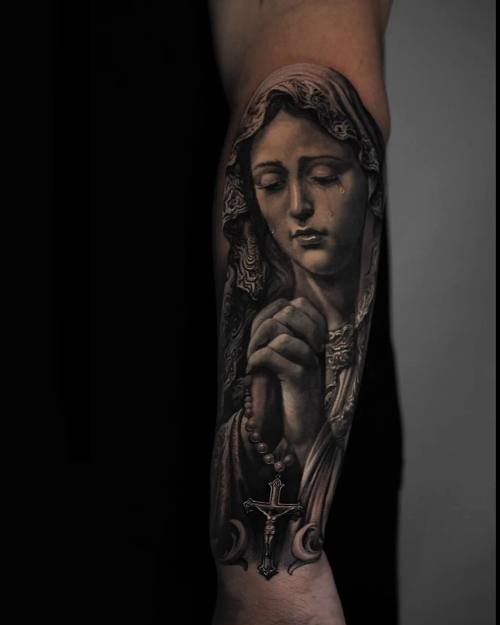
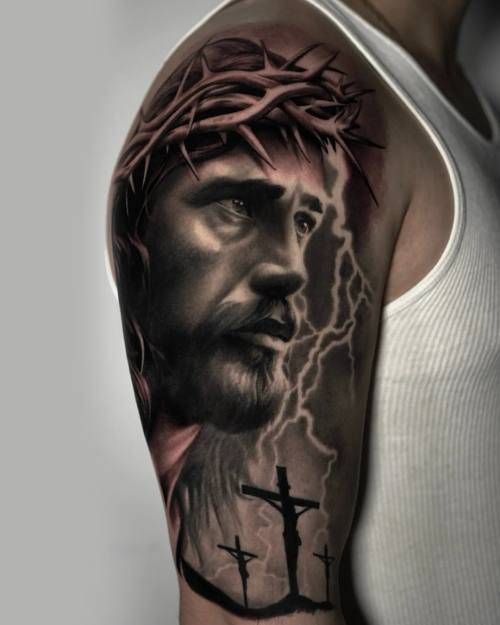
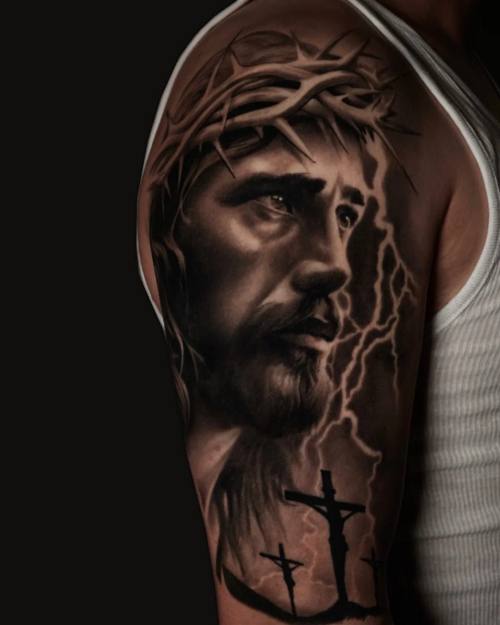
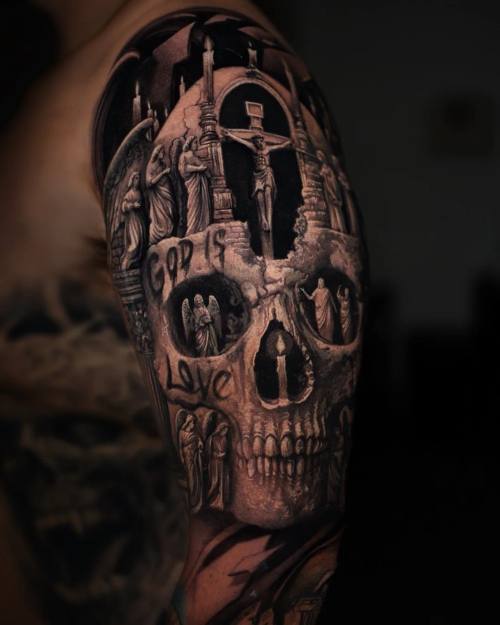
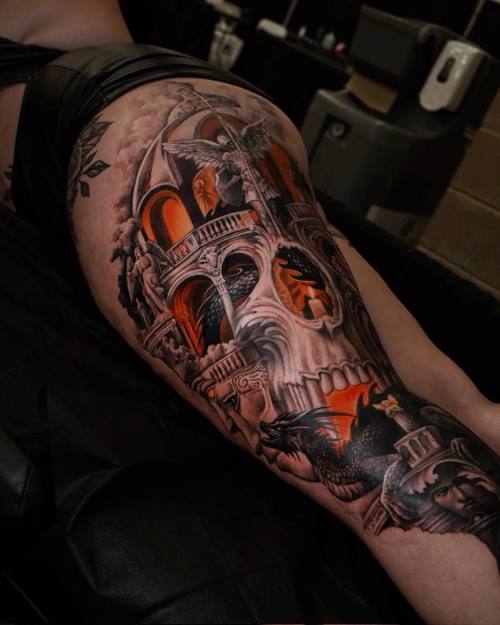
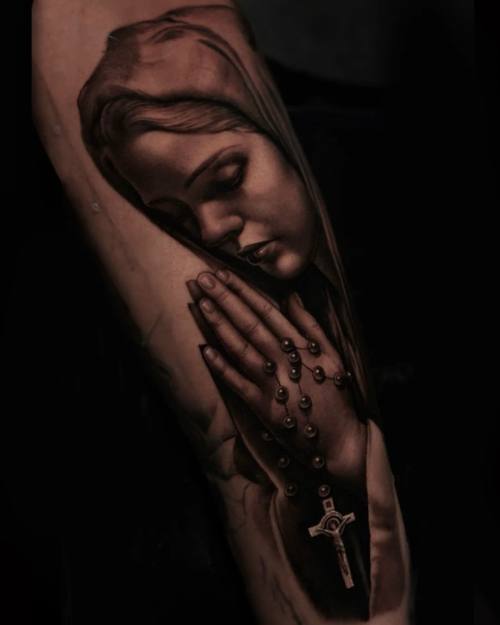
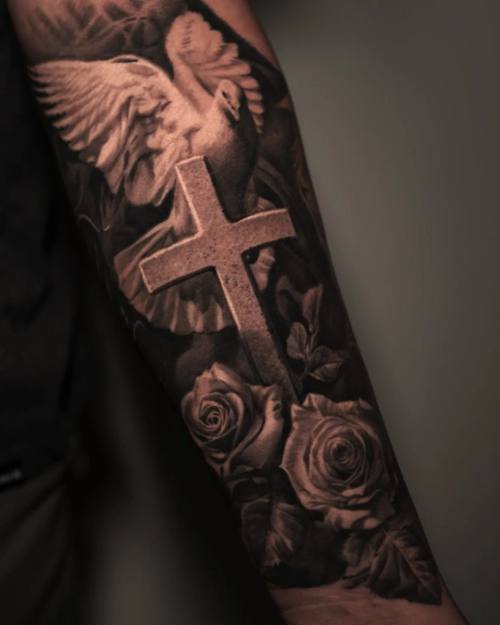
Religious and baroque work is the core of what this studio is known for: saints and Madonnas, crucifixes and rosaries, angels, marble statues, cathedral interiors and architectural detail, often built around a skull or a single figure that anchors the whole composition.
It is a different discipline from a portrait or an animal study. A baroque piece is a scene rather than a subject. It has a light source, a depth order, drapery that has to fold the way stone folds, and architecture that has to stay straight while it wraps a limb. The design is built for the part of the body it will live on, so that arches follow the shoulder and the composition still reads from a few steps away, not only in a photograph.
Vladimir Kozachenko, who founded the studio, has been tattooing for over thirteen years. He moved from classical realism into baroque, religious and sculptural work partly because of how each ages: strong contrast and clear structure hold up over decades, while soft photographic detail flattens. That is why these pieces are drawn with real blacks and open skin rather than filled edge to edge.
Adam works the same territory from the sculpture side - Greek busts, marble figures, Colosseum arches - usually framed in smoke and cloud ornament, so a sleeve keeps one clear silhouette instead of turning into a crowded collage.
What We Take On
- Full back and full sleeve religious compositions
- Saints, Madonna, Christ and archangels
- Skulls combined with cathedral interiors, statues and columns
- Marble and stone sculpture, drapery and classical busts
- Rosaries, crucifixes and sacred lettering
- Adding to and finishing existing religious work
OUR CHRISTIAN AND RELIGIOUS TATTOO ARTISTS
Selected work
Planning Your Visit
Age
We tattoo and pierce adults only - 18 and over, no exceptions. California law makes tattooing anyone under 18 a misdemeanour (Penal Code 653) and the Safe Body Art Act sets the same limit (Health and Safety Code 119302). The state does allow piercing a minor with a parent or guardian present, and bans nipple and genital piercing on minors outright, but our own rule is simply 18 and over.
Consultation
Free. Text us, call the studio, or come in - the front desk answers the practical questions and the artist takes the design ones.
Booking and deposit
A deposit secures your date and comes off the final price. Some artists take walk-ins for small work; large projects are booked with a specific artist and often months ahead. Guest artists from other states and countries work here through the year.
Sessions
A working day usually runs from noon to around 6pm, sometimes 7pm, with breaks; artists set their own pace and their own day.
Touch-ups
A touch-up after healing is free when the artist judges the piece needs one - they will tell you at the end of the session or when you send healed photos.
Languages
English, Spanish, Russian and Serbian are spoken in the studio.
Finding us
7224 Melrose Ave, Los Angeles. Street parking on Melrose, plus a paid all-day lot across the road; the studio has no lot of its own. The entrance is on Melrose with no step, and the restroom is wheelchair accessible. Open 12pm to 8pm, seven days.
Payment
Credit and debit cards, cash, Zelle, Apple Pay and Google Pay.
Standards
The studio works under the California Safe Body Art Act and Los Angeles County Public Health rules for body art.
Christian and Religious Tattoo Questions
How many sessions does a full back religious piece take?
It depends on the scale and how much detail the composition carries, so a back is planned as a multi-session project across months, with healing time between sessions. Your artist gives you a session plan at the consultation rather than a number over text.
Do I have to be religious to get this kind of tattoo?
No. Many of these pieces are chosen for the sculpture, the architecture and the composition rather than for faith, and we design them either way.
Can a religious composition be built around tattoos I already have?
Often yes. Existing work can be absorbed into a larger scene, and where the old piece is too dark to build over we will say so and tell you when laser lightening would help first.
Why is this style done in black and grey rather than colour?
Contrast and structure are what make stone, drapery and architecture read as solid. Black and grey holds that structure as the tattoo ages, which is the same reason the style is drawn with real blacks rather than filled edge to edge.
From the journal
Archangel Michael Tattoo Meaning: Symbols, Scripture and HistoryWhat an Archangel Michael tattoo means: his name, the war in heaven, and the meaning of the sword, armour, shield, scales and defeated devil, symbol by symbol.